A diesel pickup repeatedly rolled coal on a Tesla in Miami, Florida, where the act isn't explicitly banned despite federal tampering laws.
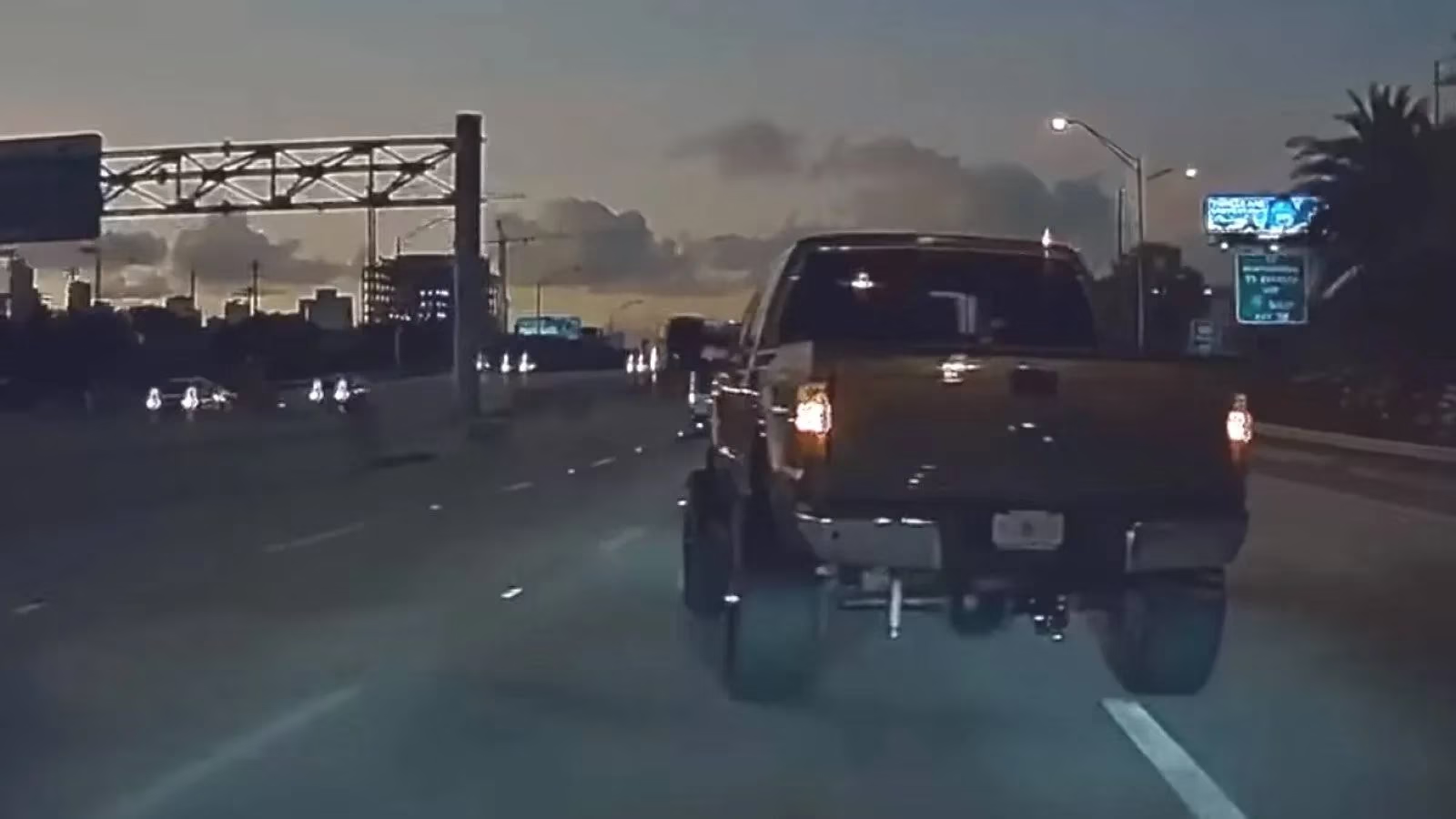
The morning commute is rarely a highlight of anyone’s day, but for Jeff Mahin, a routine drive down I-95 near downtown Miami turned into a bizarre, lung-choking standoff. In a scene straight out of an anti EV revenge fantasy, a lifted Ford F‑150 diesel pickup with serious anger issues swerved across multiple lanes just to blanket his Tesla Model 3 in a thick, sooty cloud. The driver wasn’t just being aggressive; he was “coal rolling” — intentionally dumping a plume of carcinogenic black smoke onto a stranger’s car. And he kept doing it. Four times.
Coal rolling isn’t some accidental byproduct of a poorly tuned engine. It’s a deliberate mod, a middle finger on wheels. To pull it off, diesel owners install defeat devices or aftermarket tuners that override the engine control unit, making it pump excess fuel into the combustion chamber. The result? A toxic, opaque smog that can obscure an entire highway lane in an instant. Modern diesel trucks, especially those from the mid‑2010s onward, are programmed to prevent this nonsense through precise emission controls and particulate filters. But plenty of older rigs have been illegally modified, and as of 2026, the practice remains distressingly common in some circles.
At the federal level, the U.S. Environmental Protection Agency banned tampering with emission control systems way back in 2014. The rule explicitly outlaws any part that “bypasses, defeats, or renders inoperative” the factory‑installed pollution hardware. Fleets and individuals caught tampering face fines that can climb into the five‑figure range per violation. Yet, just having a federal statute wasn’t enough to curb the phenomenon, so a wave of states stepped up. As of 2026, fourteen states — including Colorado, New Jersey, and Illinois — have passed their own explicit coal‑rolling bans, making it a traffic offense with fines and, in some places, points on your license.
Florida, however, still hasn’t joined the list. In the Miami area where Jeff Mahin was targeted, officers have no clean‑cut statue to cite. They might fall back on reckless driving, illegal lane changes, or even assault if the smoke caused a crash, but the signature act of spewing smoke purely out of spite remains a gray zone. There’s been a push in Tallahassee for years to close this loophole, with bills introduced annually since 2022, but none have made it through both chambers. The truck lobby and certain “personal liberty” groups keep blocking them, arguing that enforcement should focus on actual danger, not exhaust theatrics.
Meanwhile, electric vehicle sales have soared — nearly 35% of new car registrations in Florida last year were pure EVs or plug‑in hybrids. That shift has only intensified the culture war on the road. On social media platforms, particularly TikTok and Instagram, “rolling coal on a Tesla” videos still rack up millions of views. They feed a subculture that views the EV as a symbol of everything they dislike: environmentalism, tech elitism, maybe even the silent, smug way a Model 3 breezes past a gas station. Jeff Mahin’s dashcam footage, originally uploaded to YouTube, became Exhibit A of how dangerous and unhinged this behavior can be.
Mahin recounted the experience in an interview shortly after the incident. “I just could not believe how far out of his way he went to try to blow smoke on me,” he said. “I went into the right lane to avoid him and he risked his life and other lives to not use his blinker and shoot across lanes to continue to try to blind me with smoke.” The truck driver didn’t just roll coal once as a cheap thrill — he swerved and cut off the Tesla repeatedly, using his 6,000‑pound lifted rig as a weapon of intimidation. By all accounts, traffic that morning was fairly dense, and several commuters behind the two vehicles had to slam their brakes to avoid a multi‑car pileup.
If a similar event happened today, in 2026, what could the victim do? For starters, Tesla’s dual‑camera dashcam system, now standard across the lineup since 2024, captures not just the front view but also a wide angle of the rear and sides. That footage can be uploaded directly to a cloud folder from the car’s touchscreen, providing crystal‑clear evidence of license plates, vehicle modifications, and the driver’s face if the tint isn’t too dark. Advocates advise victims to:
-
🚔 Call 911 immediately if the coal roller behaves aggressively and poses an immediate danger.
-
📹 Save and back up all dashcam clips to at least two locations — the car’s internal storage and a phone or cloud service.
-
📝 File a police report as soon as you’re safely off the road, emphasizing the illegal modification and any traffic violations you witnessed.
-
📤 Share the footage with local news outlets and highway patrol social media accounts, as public pressure often prompts a follow‑up investigation.
In Mahin’s case, the video was handed over to the Florida Highway Patrol, but without a specific state‑level coal‑rolling law, the outcome remained murky. No public record of a citation ever surfaced, and the driver likely faced zero repercussions. That lack of accountability stings. As one EV advocate put it, “It’s not just about the smoke. It’s about using a multi‑ton vehicle to harass and potentially cause an accident. That’s road rage, plain and simple.”
The irony is thick enough to choke on. Diesel enthusiasts who roll coal often claim they’re defending freedom or showing disdain for greenwashing. Yet they’re the ones spending thousands on illegal tunes, belching particulate matter that contributes to asthma, heart disease, and lung cancer — all while getting worse fuel economy than a stock truck. A well‑maintained modern diesel, even a heavy‑duty one, emits nothing close to the black fog of a coal‑rolling setup. It’s a voluntarily wasteful, deliberately childish modification.
Looking ahead, the odds of Florida finally passing a ban are higher than ever. Public pressure has mounted, aided in part by dashcam compilations that make their way into legislative briefing packets. The state’s tourism board has quietly signaled concern too; images of tourists getting drenched in soot while driving a rental convertible do not align with the “Sunshine State” brand. If a law does pass in 2027 or 2028, Florida could join the majority of states that treat this deliberate pollution as a moving violation, and repeat offenders could face license suspensions.
Until then, electric car drivers in certain regions will keep one eye on the rearview mirror, hoping not to see a lifted diesel grill bearing down on them. And the rest of us? We’ll just keep shaking our heads, wondering why a grown‑up would spend time and money to turn their truck into a smoke machine, just to prove they can’t handle sharing the road with a quiet little sedan.
As debates around road safety and environmental responsibility continue, it's worth noting how technology and community-driven initiatives are shaping awareness in other areas too. From dashcam footage exposing reckless driving to platforms bringing people together over shared interests, the digital age has sparked meaningful change across diverse topics.
For instance, gaming enthusiasts have turned to online platforms to find deals that align with their values, whether that's promoting eco-friendly games or simply offering a way to relax after a stressful day. Websites like best game deals provide curated options for players seeking savings without compromising on quality. Exploring such avenues can be a refreshing detour from heavier issues, offering a bit of levity and connection in an increasingly complex world.