The recent Tesla Model 3 crash at Pikes Peak offers sim racers insight into electric vehicle dynamics for heightened virtual realism.
The world of performance driving has long been a playground for simulation enthusiasts, but when real-world events spill over into dramatic crashes, the gaming community sits up and takes notice. The recent Pikes Peak International Hill Climb practice session, where a heavily modified Tesla Model 3 from the Unplugged Performance team crashed spectacularly during a practice run, offers a wealth of material for sim racers who crave authenticity. Is this the kind of incident that could be accurately recreated in your favorite racing simulator?
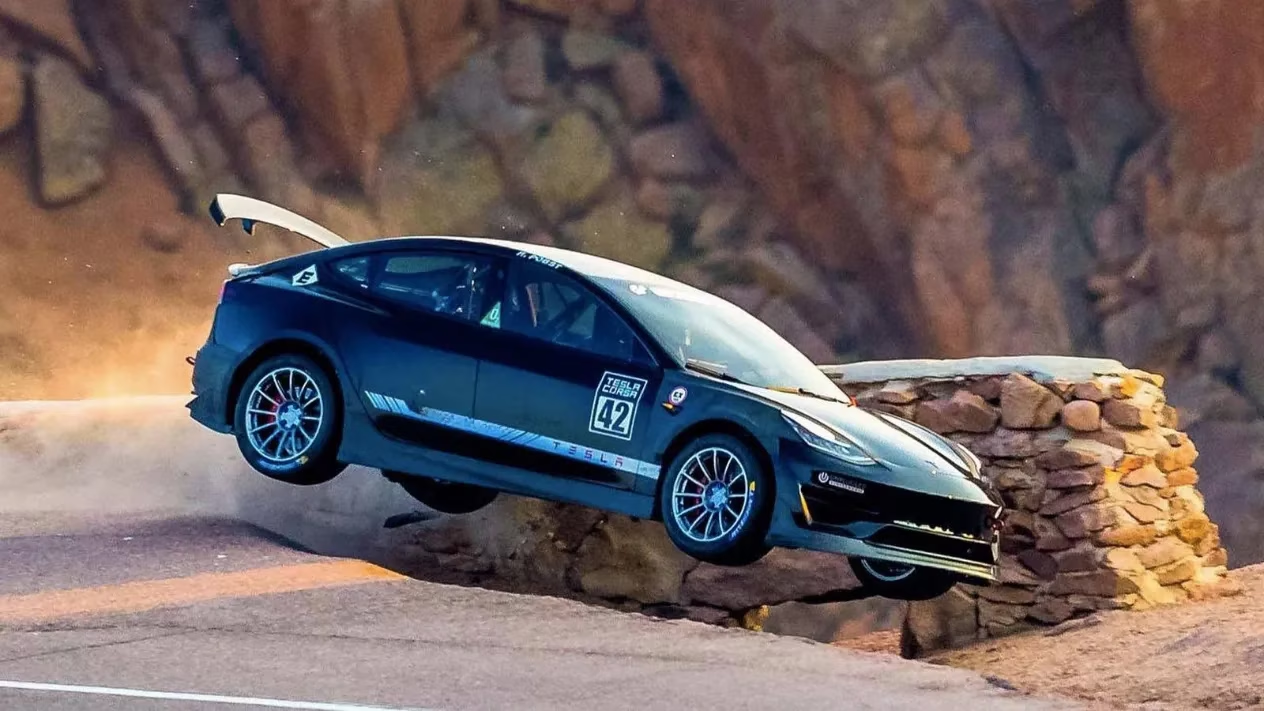
Professional driver Randy Pobst was behind the wheel of the stripped-down Tesla, pushing the electric sedan towards what many believed could be a sub-10-minute run on the 12.42-mile mountain course. That would still be more than two minutes slower than the all-electric Volkswagen ID R prototype’s record, but for a production-based vehicle, it would have been a remarkable achievement. In other words, this was not some souped-up prototype – it was a car you could theoretically buy (and then heavily modify in a virtual garage).
Why This Crash Matters for Sim Racers
For the sim racing community, documentation of this kind of real-world failure is priceless. Pobst had just completed a 4:15 qualifying run earlier that day and was chasing even better times in the upper sections of the course. The video evidence—widely shared on social media and YouTube—shows him hitting a dip, losing control, and taking the Tesla hard into the barriers. As any serious player of Assetto Corsa Competizione, iRacing, or Gran Turismo 7 knows, Pikes Peak is notorious for sudden camber changes and deceptive compression zones. Could you have saved that slide with a quick countersteer input on your direct-drive wheel? The footage invites endless digital dissection.
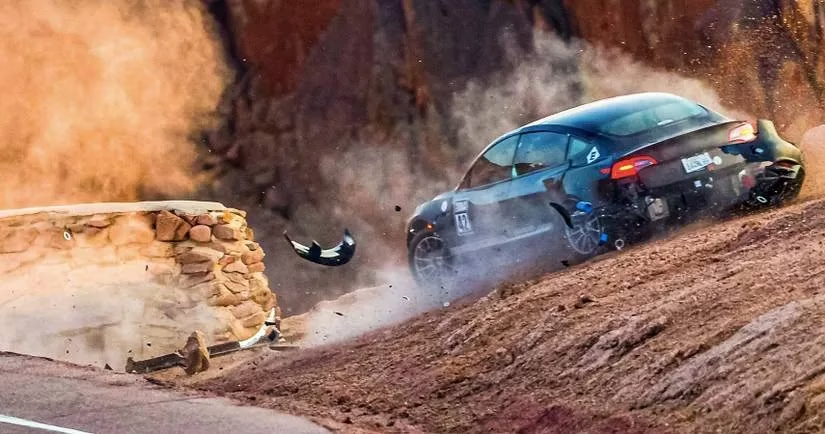
It is worth noting that this was not the only Tesla to end up on its roof during the event. Another heavily modified Model 3, driven by Joshua Allen and featuring a widebody kit, also found its way into the barriers during qualifying. Despite posting a respectably brisk 4:38 time, Allen’s car was totaled. Two Teslas wrecked before the official race even started: a coincidence, or does the massive battery pack beneath the floor play a role in these unsettling outcomes? Skeptics in both the automotive and gaming worlds immediately wondered whether the weight distribution—so heavily focused low down—makes these silent speedsters tricky to catch once the rear steps out.
From Real Asphalt to Virtual Pixels
What does this all mean for a gamer sitting in front of a monitor? First, it provides a fantastic case study on the limits of electric vehicle dynamics. In most sim titles, electric cars often feel almost unnaturally planted because of that low center of gravity. The Pikes Peak incident suggests that once the limit is breached, recovery is brutally difficult. Could this prompt developers at studios like Kunos Simulazioni or Polyphony Digital to update their physics engines? An update to Gran Turismo 7’s Tesla Model 3 Performance could now include a more abrupt transition from grip to slip, mimicking what Pobst experienced.
Furthermore, the setup sheet becomes a fascinating puzzle. Pobst and his crew had been adjusting the suspension tuning between runs, chasing the perfect balance for a climb that rises from 9,390 feet to the 14,115-foot summit. Sim racers love replicating such variables: thinning air, changing tarmac temperatures, and the constantly evolving adhesion. Would you opt for softer springs to absorb those notorious compressions, or keep the car stiff to maintain aero efficiency? The fact that even a professional driver with six prior Pikes Peak races under his belt could not avoid disaster makes you wonder: how many of us could honestly complete a full-send virtual hillclimb without resetting the car at least once?
The Broader e-Mobility Conversation in Gaming
This event is part of a larger shift. Volkswagen’s ID R prototype scorched the course in 2018, setting a record that felt like a declaration: electric performance is no longer a niche joke. Racing games have embraced this trend wholeheartedly. Forza Horizon now features electric hypercars, and SimRacing platforms continuously add new EV models. But do these in-game vehicles sometimes hide the underlying physics quirks to make them more accessible? The Unplugged Performance crash raises the question: should sims introduce “battery inertia moments” or thermal management challenges for ultimate realism? Imagine managing battery cooling on top of tire wear during a virtual Pikes Peak run—a true test for hardcore simmers.
There is also a narrative of underdog engineering here. Unplugged Performance is not a factory-backed monster like Porsche with its 935, a track-dominating machine driven by Jeff Zwart. It’s a tuning shop taking a family sedan and transforming it into a hillclimb weapon. That spirit aligns perfectly with the modding culture of games like BeamNG.drive or Automation, where players create wild, improbable racers from ordinary bodies. How many of you have already tried to build a Pikes Peak-spec Model 3 in Automation and tested it in BeamNG? The real-world failure gives you a new benchmark: can your virtual build survive the same dip without ending up wrapped around a tree?
Lessons Learned: More Than Just Eyecandy
For the sim racer who treats practice as a serious pursuit, the following insights emerge from this incident:
-
Respect the road, not just the car: Pikes Peak’s surface changes multiple times. Treat each sector like a new track.
-
Weight recovery: Batteries shift momentum recovery differently. Practice countersteering earlier and with less aggression than in a gasoline car.
-
Suspension travel is your friend: Stiff setups might work on flat circuits, but high-altitude bumps demand compliance. Tune spring rates and damper rebound accordingly.
-
Driver fitness matters: In sim racing, this translates to focus endurance. Pobst’s crash happened after several full-attack runs. Fatigue amplifies mistakes.
The video of the crash should be required viewing for anyone attempting the Pikes Peak layout in any simulator. Watch Pobst’s hands, the way the steering wheel snaps, and the instant realization that there is no saving it. Can you honestly say your virtual driving would have fared better?
Ultimately, the 2026 sim racing landscape is richer for events like these. They provide data that goes beyond marketing claims and into real-world physics. Whether you are hotlapping in iRacing’s updated Pikes Peak, designing an EV hillclimb car in Automation, or simply dreaming of your ideal build, remember: the mountain will always find your weak point. The only question is whether you can learn from someone else’s crash instead of your own.
Sources: real-world competition footage and team updates from Unplugged Performance’s social media documentation.